No consumer phone is waterproof
Let's start with the truth every manufacturer prints in small font: no consumer smartphone is waterproof. They are, at best, water-resistant, and the resistance is measured under strict laboratory conditions that don't match real life. That doesn't mean IP ratings are meaningless — they're actually a great predictor of how well a device will survive water — but they don't mean "you can take it in the pool forever with no consequences."
Decoding the IP code
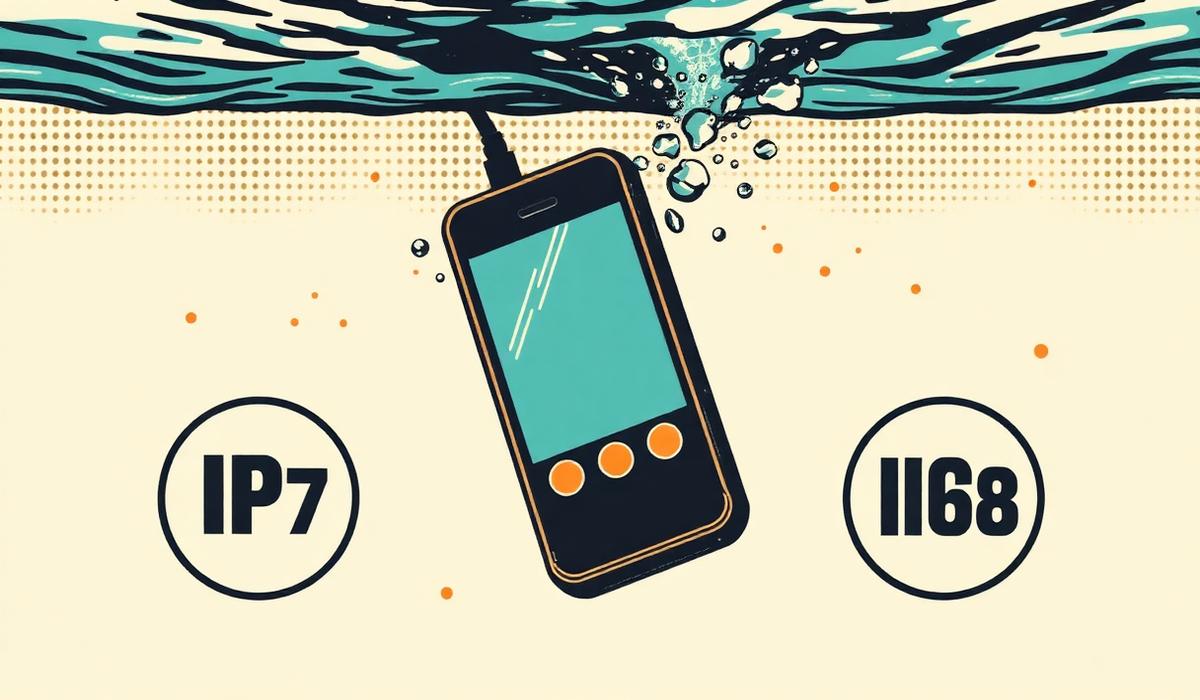
IP stands for Ingress Protection. The two digits after "IP" measure protection against two things:
- First digit (0–6): solids. How well the device resists dust, dirt, and small objects.
- Second digit (0–8 or 9K): liquids. How well the device resists water.
An "X" in either slot means "not tested" — so an IPX7 speaker was tested for water but not certified for dust.
The liquid digit — what each level actually means
| Rating | What it survives |
| --- | --- |
| IPX4 | Splashes from any direction — rain, sweat. |
| IPX5 | Low-pressure water jets. |
| IPX6 | High-pressure water jets from any direction. |
| IPX7 | Immersion up to 1 meter for 30 minutes. |
| IPX8 | Continuous immersion, depth defined by manufacturer. |
The critical detail: IPX8 doesn't mean any depth for any time. Each manufacturer publishes their own IPX8 spec. Apple's IP68 on the iPhone 15 Pro is rated for 6 meters up to 30 minutes; Samsung's IP68 on the Galaxy S24 is 1.5 meters up to 30 minutes. Same rating, very different real-world tolerance.
What the rating doesn't cover
IP ratings are for fresh water only. The following are not covered by any IP rating:
- Chlorinated pool water — swimming pool trips void most warranties, even on IP68 devices.
- Salt water — highly corrosive to the internal seals and speaker meshes. A single ocean dip can start corrosion that shows up months later.
- Soapy water — soap dramatically lowers water's surface tension, which lets it seep through gaskets that were rated for plain water.
- Hot water — steam and thermal expansion can defeat seals.
- Pressurized water — showers and jet washes, even at low pressure, can exceed the pressure the device was tested at.
This is why manufacturers void water damage warranty claims almost universally. It's not a scam — it's that real-world water exposure almost never matches the sterile, still, fresh-water lab conditions the rating was earned under.
What this means for your speaker
Even an IP68 phone can end up with a muffled speaker after a splash. The rating protects the internals, not the acoustics. Water in the speaker grille is expected on any device, waterproof rating or not. What the IP rating buys you is peace of mind that the electronics behind the speaker mesh will keep working while you eject the water from the front.
Practical rules of thumb
- Treat IP68 as "will survive being dropped in a sink." Not "will survive a snorkeling trip."
- After any water exposure, run a sound-based water ejection immediately, before minerals dry in the speaker chamber.
- Rinse with fresh water after pool or beach exposure. Chlorine and salt cause damage even after the water evaporates.
- Dry the exterior thoroughly before charging. Water in the USB-C port can trigger a "Liquid Detected" warning and refuse to charge.
- If your device gets submerged in salt water, get it professionally rinsed within 24 hours. Cost of a rinse is small compared to a replacement.
Bottom line
The IP rating is a floor, not a ceiling. It tells you what the device survived in a lab, not what it will survive in your life. Assume you'll get water in the speaker eventually, and know that a 30-second sound ejection almost always fixes it. That's why we built this site.